


Author
Matthias Wolf
Workday can bring job requisitions, recruiting information, job details, locations and qualifications together in one system. It can also support posting jobs to internal, external and agency career sites.
At the same time, recruiting teams still need to get those jobs in front of the right candidates and understand which media investments are contributing to hiring outcomes.
When recruiters manually post jobs across individual boards, track performance and move budgets themselves, the process can quickly become time-consuming. The requisition may be centralized in Workday, while the media strategy remains spread across different channels and platforms. That disconnect can make it harder to use recruiting data and intelligence across the hiring journey – and harder to get the full efficiency and value from your Workday investment.
Manual Job Posting Takes More Time Than You Think
Posting one job manually may only take a few minutes. Across hundreds or thousands of requisitions, those minutes add up.
For every role, someone needs to decide where to advertise it, create or adapt the posting, monitor the results, adjust the spend and recognize when a channel has stopped delivering.
That is time recruiters could spend engaging candidates, working with hiring managers and moving strong candidates through the process.
There is also the media budget to consider.
The programmatic advertising market is placing greater emphasis on quality, accountability and smarter use of data. As talent acquisition teams face pressure to make every hiring dollar work harder, recruitment media is shifting toward greater accountability, smarter use of data and optimization tied to measurable hiring outcomes.
For talent acquisition teams, the takeaway is simple: more clicks do not always bring you closer to the right hire.
Better Metrics Create a Clearer View of Programmatic Job Advertising ROI
Cost per click, or CPC, is easy to track, but it only tells part of the story.
A job can attract plenty of inexpensive clicks without producing candidates who move forward. Another source may cost more per click but deliver candidates who are much better suited to the role.
Measuring performance further across the hiring journey – from click to application and ultimately hire – gives talent acquisition teams a clearer view of which media investments are contributing to hiring outcomes.
The logic is straightforward: If a channel generates traffic but no qualified candidates, a low CPC is not delivering much value.
The further you can measure across the hiring journey, from click to application, qualified candidate and hire, the more meaningful your view of programmatic job advertising ROI becomes.
Programmatic Job Advertising Handles the Repetitive Work
Programmatic job advertising automates many of the day-to-day decisions involved in distributing and optimizing recruitment media.
Instead of deciding where to promote every individual job, AI-powered and increasingly agentic technology can use performance signals to identify which publishers and channels are working for specific roles and locations, then take action based on those insights. It can test sources, optimize bids and dynamically move spend toward the media delivering stronger results – automating more of the ongoing decision making and execution that recruiters would otherwise have to manage manually.
Radancy’s Programmatic AdTech uses AI and performance intelligence to continuously improve how recruitment media is distributed and optimized. By learning from previous jobs and current performance signals, it can determine which sites and channels are delivering results, optimize how much to spend and continually adjust bidding strategies across programmatic search, display, prospecting and remarketing.
The goal is to help teams spend less time managing media and more time focused on the people and decisions that move hiring forward.
Connected Data Makes Every Media Decision Smarter
Workday already holds much of the information behind a recruitment campaign, including requisition details, job information, locations and qualifications. It also uses requisition data to populate job postings.
Connecting that information with programmatic media helps teams make advertising decisions with greater context.
Instead of treating every job as a separate campaign, teams can connect job data with distribution, media performance and hiring outcomes.
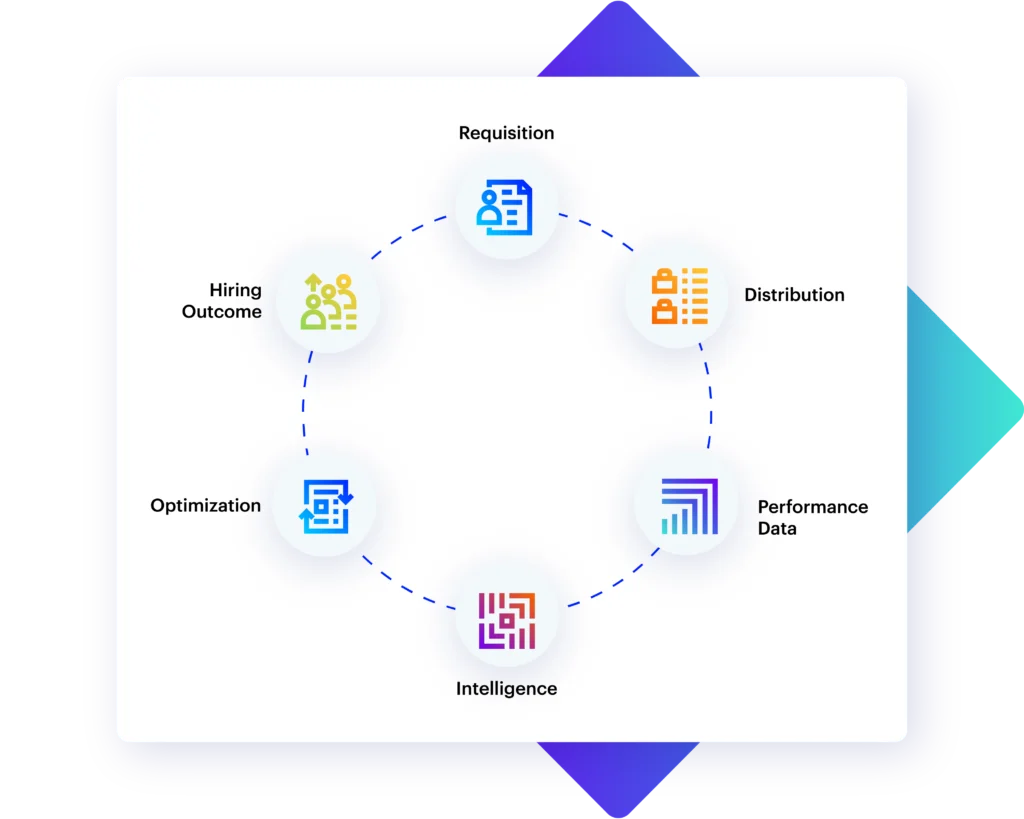
This creates a continuous cycle:
Requisition → distribution → performance data → intelligence → optimization → hiring outcome
With performance data connected across channels, teams can see more clearly where recruitment spend is contributing to applications and hires. That connected intelligence can then inform the next media decision, creating a continuous cycle of learning and optimization.
Radancy’s industry-leading, AI-powered platform reporting provides visibility into paid media performance, including cost per application and cost per hire, alongside channel-level and job-level results.
A Smarter Approach to Hard-to-Fill Roles
Consider a specialized role in a competitive market.
With manual job posting, a recruiter might choose two or three familiar job boards, publish the role and periodically check whether applications are coming in. If one source underperforms, someone needs to spot the problem, decide what to change and make the adjustment.
With programmatic distribution, the role can reach candidates across a broader media mix while the system learns which sources are performing. It can then adjust spend and bids based on actual results instead of relying entirely on the recruiter’s initial selections.
The recruiter still leads the hiring strategy. The technology handles more of the repetitive media execution and ongoing optimization.
That difference matters. Automation should give recruiters more time to recruit, without adding another dashboard they need to manage throughout the day.
Make More of Your Recruitment Media Budget
The cost of manual job posting rarely appears as a separate line in a recruiting budget. Instead, it shows up in recruiter hours, disconnected media management, missed opportunities to optimize and spending decisions based on metrics that stop too early in the funnel.
For Workday customers, programmatic job advertising offers a way to build on the structured recruiting data already in their workflow and connect it with a media strategy that continuously optimizes toward hiring outcomes.
That makes programmatic job advertising ROI more than a media metric. It provides a clearer view of how effectively your technology, recruiters and media budget are working together – and whether recruitment media is ultimately contributing to better hiring outcomes.
If your team is still managing job advertising one posting at a time, now may be a good time to look at how much work that process creates and how much more your media strategy could achieve when it works with your Workday workflow.
Explore how Radancy connects programmatic advertising with a connected talent acquisition approach.
Keep Up With the Future of Hiring
Stay ahead of what’s changing in talent acquisition. Subscribe to Radancy Updates for monthly insights into AI-powered innovation, connected hiring strategies and real examples of how global organizations are simplifying hiring, reducing costs and maximizing ROI.
