

Research Basis
Radancy Labs Recruiter Workflow & Capacity Study (2026); Lee et al., American Journal of Preventive Medicine (2025)
Contributor

Jahkedda Akbar
SVP Strategy, Insights and Innovation
Contributor

Nini Longoria
Research Scientist, Mix Methods
CIOs and CHROs are increasingly expected to co-own workforce technology outcomes, and the cost of getting that wrong is larger than most ROI models reflect. According to a recent study by the Public Health Informatics, Computational and Operations Research team, the cost of employee burnout and disengagement runs to approximately $5 million annually for a 1,000-employee organization, and it rarely appears in any AI ROI model.
The individual cost of burnout runs from $4,000 for an hourly worker to $21,000 for a manager or executive. In recruiting, where 53% of practitioners report burnout in any given year, that cost compounds quickly. Yet this liability is rarely accounted for alongside HR technology spend. As a result, most AI ROI models measure efficiency gains without capturing whether those gains reduce the conditions driving that cost.
$5.04M
estimated annual cost of burnout and disengagement to a 1,000-employee organization.
CUNY Public Health Informatics, Computational and Operations Research team, American Journal of Preventive Medicine, February 2025
AI Is Delivering Efficiency, but Is It Enough?
In Radancy’s study of in-house recruiters and recruiting managers actively using AI in their daily work, 77% reported AI at least somewhat improved workflow efficiency. AI is delivering measurable efficiency gains, but when we look at how time savings from AI actually accumulates, the impact is underwhelming.
27%
of recruiters report saving five or more hours per week from AI – the point at which time savings begin to meaningfully reshape the workday.
Radancy Labs, 2026
The majority of recruiters (66%) say AI saves them between one and four hours per week. That reduces friction but does not change how the day is spent. Overall, AI is helpful but not yet transformative.
More telling, however, is how recruiters say the work feels. When asked to compare their current burnout levels to the pre-AI era, 44% said things were unchanged or worse. Only 9% said they were significantly less burned out. These recruiters have AI actively embedded in their workflows, but the burnout line has barely moved. This points to a mismatch between where AI is improving efficiency and where work is actually driving strain.
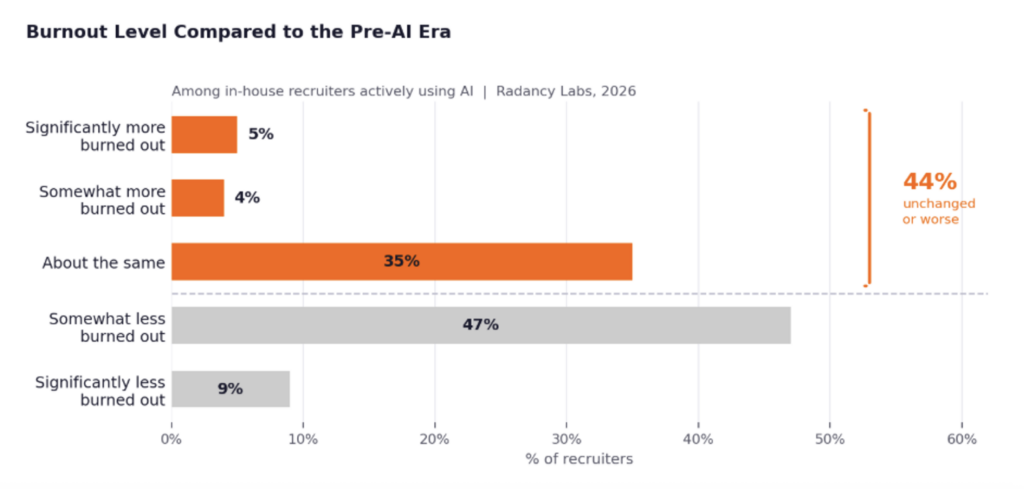
The Problem Isn’t Task Speed, It’s Workday Composition.
When we asked recruiters how their workday actually breaks down, only 45% said they spend the majority of their time on work that requires human judgment. Meanwhile, one in four are spending most of their day on coordination and logistics – scheduling, follow-up, ATS updates, hiring manager alignment – consuming five or more hours out of eight. For many recruiters, draining coordination work displaces judgement work.
The data reveals something important about the type of work that is more energizing for recruiters.
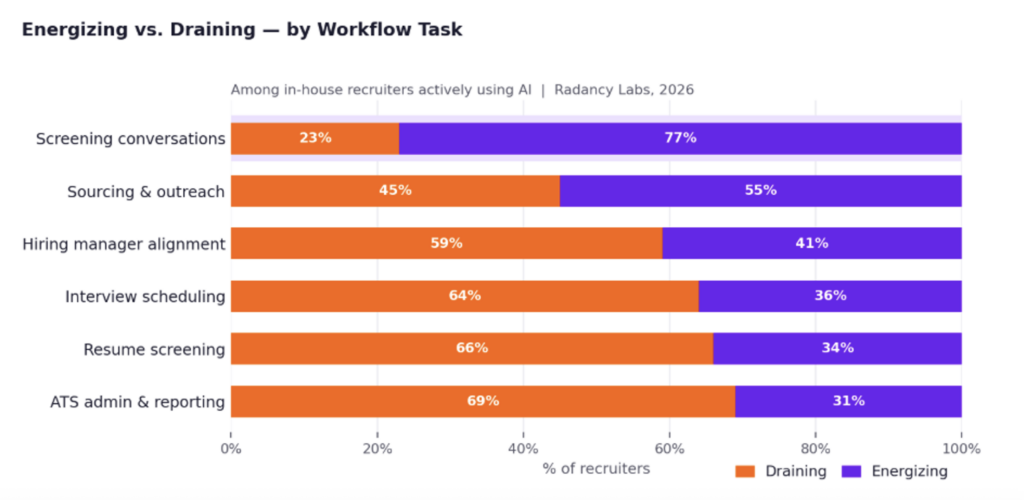
Recruiters rate screening conversations as highly energizing, but only when they involve pre-qualified candidates. When the upstream funnel hasn’t done the qualification work, the screening conversation stops being judgement and becomes triage, impacting flow and the potential for efficiency gains.
78%
of recruiters rate screening conversations as energizing, but only when those conversations are with quality candidates. When the funnel delivers volume without quality, the work becomes draining.
Radancy Labs, 2026
Qualitatively, recruiters consistently point to the human conversation, judgment and connection that shape a hiring decision as the most meaningful parts of the role. The goal is to ensure that by the time a recruiter is in that conversation, the qualification work has already been done, and their attention is where it produces the most value.
This dynamic aligns with the CUNY burnout model, which identifies workload – especially work perceived as overwhelming or low in meaning – as the primary driver of the disengagement-to-burnout trajectory. A recruiting workflow that displaces judgement work or consistently pushes unqualified volume to recruiters creates the conditions for burnout, even within tasks that should otherwise be engaging.
The most important number in your AI ROI calculation isn’t hours saved. It’s the share of the recruiter’s day that returns to judgment work.
Where AI Closes the Gap: Workflow Absorption, Not Task Optimization.
Our analysis found that AI-driven time savings are a statistically significant predictor of burnout. The more hours AI saves, the lower burnout tends to run relative to baseline. This points toward a specific model of how AI investment should be evaluated.
The highest-value AI deployments in recruiting are those that absorb whole categories of work. When intelligent screening, automated scheduling and integrated documentation work as a connected experience, rather than separate tools, the coordination work is absorbed and a recruiter’s day realigns around judgement.
The real ROI is not incremental efficiency gains, but in reducing the disengagement stressors that generate the annual $5 million burnout costs in the first place.
What Talent Acquisition Leaders Should Be Asking.
For talent acquisition leaders, the relevant question is no longer whether to invest in AI. Adoption is already underway, and the baseline benefits are established. The question is which investments change how recruiters spend their workday.
A practical test: Does the solution meaningfully increase the proportion of time spent on judgment-based work? Does it ensure that recruiter interactions are focused on qualified candidates? Incremental improvements produce incremental returns. Structural changes, where coordination work is absorbed upstream and judgment work is protected downstream, have a direct impact on hiring quality, candidate experience and retention.
Those outcomes are measurable through time to fill, offer acceptance and avoiding replacement costs. But they require shifting the focus of measurement. The right AI investment does more than save time. It changes the work.
The right AI investment doesn’t just save minutes. It gives recruiters their job back.
