

Research Basis
Frontline Worker Quality Study (2025); Frontline Recruiter Quality Study (2025); Radancy Network Survey Benchmarks (2025); BLS JOLTS Data (2025)
Contributors

Jahkedda Akbar
SVP Strategy, Insights and Innovation

Nini Longoria
Research Scientist, Mix Methods
High turnover defines frontline and hourly hiring. According to the Bureau of Labor Statistics, in food service and hospitality, more than 65% of the workforce turns over each year. Retail sees 45% turnover. Transportation and warehousing, 51%. Across sectors employing nearly 39 million workers in the US, these figures have held steady, signaling hiring processes are designed around continuous replacement.
While some churn in frontline and hour sectors is expected, across these sectors persistent turnover is not fully explained by layoffs or seasonal fluctuations. The data shows that 67% are voluntary quits. Workers are choosing to leave after they enter a role, and our research shows this decision is often made quickly.
56%
average annualized churn rate across frontline/hourly sectors.
67%
of those exits are voluntary – workers choosing to leave.
U.S. Bureau of Labor Statistics JOLTS data, 2025.
Frontline Workers Want Fit, Not Just a Paycheck.
The dominant assumption in frontline hiring is that workers are largely transactional: workers need jobs, employers need bodies and speed is the primary variable. This assumption shapes everything downstream – the metrics recruiters are measured against, the job content that gets written and the screening processes that get built.
Radancy’s proprietary survey data, drawn from 173,000 frontline and hourly job seekers who completed candidate motivation surveys on employer Career Sites in our network, tells a more layered story. When asked what motivates them at work, frontline job seekers prioritize learning opportunities, followed by stability and the ability to positively impact others. These reflect broader career motivations.
#1
Work motivator for frontline and hourly job seekers: The opportunity to learn. Stability and security ranks second, and positively impacting others’ lives ranks third.
Radancy Network Survey Benchmarks, 173,737 frontline/hourly respondents, 2025 – “What motivates you most at work?”
Those intrinsic motivators describe what frontline workers want from their working lives in general. But when evaluating a specific job, motives differ. Compensation and benefits rank first (20%), followed by career advancement (18%) and purpose (17%). Pay establishes a baseline. Once that threshold is met, other factors determine the quality of a candidate who continues in the process.
Once compensation clears that bar, what matters most is the employer itself. When asked what is most important to them, 42% of frontline job seekers say being with the right company, above having the right job (36%) or the right people (22%). Employer brand, culture and values are decisive factors in a multi-step evaluation process that most job postings never acknowledge.
Our frontline research reinforces this point. We found that workers link fit directly to tenure. When the job aligns with expectations, they stay. When it does not, they leave quickly. Sixty-five percent of frontline workers agreed with the statement, “What matters to me most is the right fit because I like having longevity, not bouncing around from job to job.”
Early Exits Are Driven by Misalignment That Is Immediately Visible.
The voluntary exit rate becomes more explanatory when paired with reported reasons for leaving. We found that 83% of workers who left a job within 90 days cited job misrepresentation as a factor; 50% indicated that it was their primary reason.
83%
of frontline workers who left within 90 days cite job misrepresentation as a factor in their exit, 50% as the primary reason and 33% as contributing.
Radancy Frontline Worker Quality Study, N=110, 2025
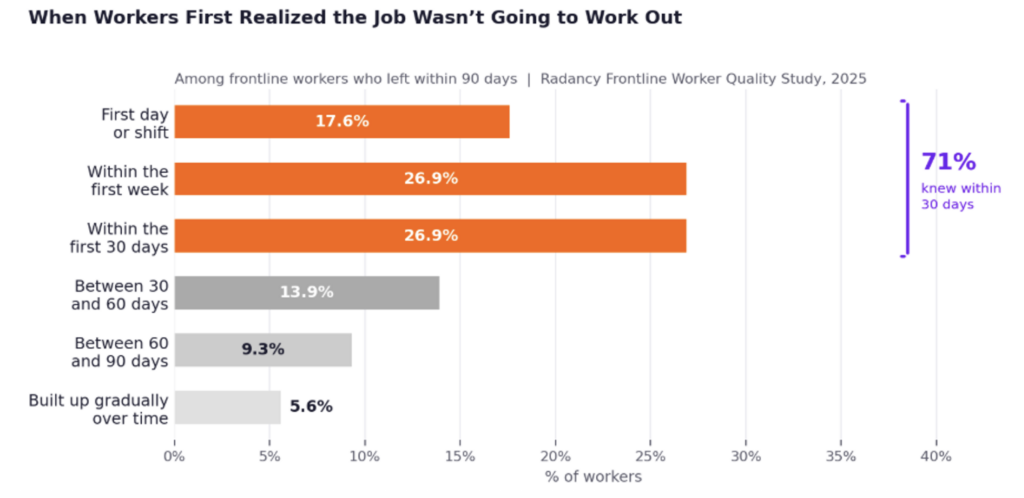
Figure 1: How quickly workers recognized the job wasn’t going to work. Among frontline workers who left within 90 days – Radancy Frontline Worker Quality Study, 2025
The timing of those exits shows how quickly that mismatch becomes apparent. 71% of workers knew the job would not work within the first 30 days, and 18% knew on their first shift.
These are not gradual realizations. They reflect immediate gaps between what was described during hiring and what the role actually required.
The specific gaps that drove those exits are consistent and specific (see Figure 2).
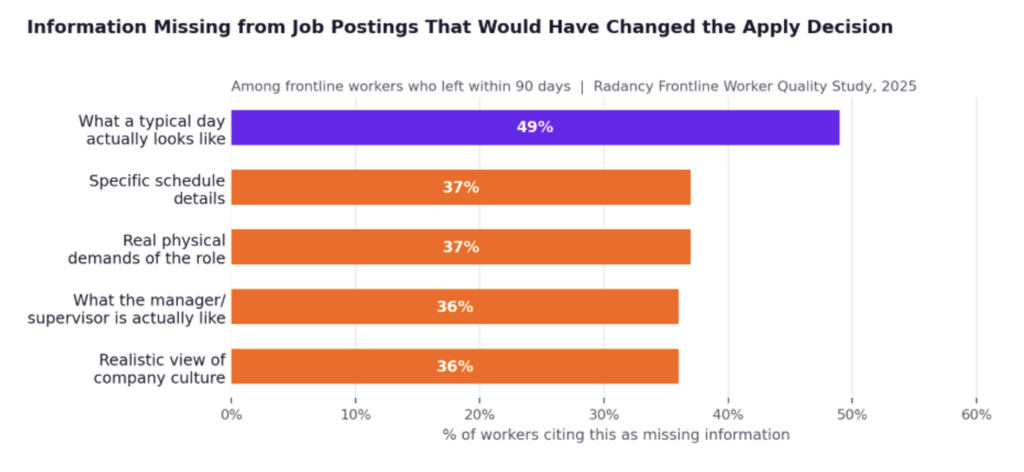
Figure 2: Information missing from job postings that would have changed the decision to apply. Among frontline workers who left within 90 days – Radancy Frontline Worker Quality Study, 2025
This information exists inside the organization. It is simply not represented clearly enough in job content or early screening.
Recruiters See the Same Problem, but Lack Control Over It.
Qualitatively, recruiters describe the same pattern from the other side of the table. Some lean into full transparency, setting expectations early – even at the risk of losing candidates – and report better retention as a result.
But many operate under constraints that limit how candid they can be. Many recruiters face pay disclosure restrictions that prevent them from sharing compensation specifics even when candidates ask directly. Speed and volume metrics can override quality judgment. Abstract compliance language – “24/7 operation,” “flexible schedule” – meets the letter of the requirement without giving candidates the concrete detail they need. One recruiter described, “[Candidates] say, ‘Sounds good,’ but then they come to training and drop off … they didn’t understand what 24/7 really meant.”
Workers aren’t leaving bad jobs. They’re leaving jobs that weren’t honestly described.
Recruiters also describe candidates applying broadly without reading job details (“rage applying”), creating high application volume with little alignment. Frontline workers reported the same behavior: 41% apply to as many roles as possible and evaluate later, while 44% skim postings or focus only on title and location before applying. This behavior reflects the information available. When job content does not provide enough detail to evaluate fit, there is little reason to invest time upfront. Thin content shifts the burden of evaluation to after the hire, where the cost is turnover.
Both Workers and Recruiters Describe the Same Solution, but Neither Has the Tools To Execute It.
What stands out in the research is the alignment between workers and recruiters when asked how to improve hiring outcomes.
Workers want questions that reflect their actual constraints and priorities; schedule compatibility, pay expectations, physical demands, work environment and long-term goals. They want to understand whether the role fits their life before committing. 61% of frontline workers agreed with the sentiment, “Companies could make the screening questions very relevant to the job, instead of random questions like tricky quizzes.”
Recruiters want to surface those same signals early: motivation, expectations and realistic constraints. They are looking for ways to identify candidates who understand the role and are likely to remain.
When screening reflects the actual conditions of the job – schedule structure, team environment, growth path and day-to-day work – it shifts from filtering candidates to clarifying fit. Candidates can assess whether the role works for them. Recruiters can identify alignment earlier in the process. Overall, this reduces reliance on application volume and shifts the funnel toward self-selection.
Workers are also willing to invest in that process. 85% report they would spend an additional 10–60 minutes applying if it increased their likelihood of staying in the role.
85%
of frontline workers would spend an additional 10–60 minutes on an application if it increased their likelihood of staying in the job.
Radancy Frontline Worker Quality Study, N=110, 2025
Workers are not asking for a faster process. They are asking for a better one. A hiring experience that surfaces compensation clearly, represents the employer honestly and screens for mutual fit captures both groups.
The hiring experience that earns that investment treats the pre-apply moment as a two-way evaluation: Here is what this job actually is, here is what a typical day looks like and here is what the schedule will do to your life. Employers who deliver that content, concretely, specifically, without hiding behind compliance language, get better self-selection. Candidates who aren’t a fit leave the funnel before day one rather than before day thirty. The ones who apply with full information stay longer.
BLS data shows what the alternative costs. A 56% annualized churn rate across frontline and hourly sectors employing 39 million people generates an estimated 21 million hire events annually. Hiring efficiency across these sectors runs at approximately 103%. Meaning employers are hiring at essentially the same rate as they are losing people. They are not building a workforce. They are maintaining one in a state of constant replacement.
The revolving door is expensive. The research is clear about what drives it. The fix is job content that tells the truth early enough for workers to make a well-informed decision and screening that treats fit as a shared goal rather than a gatekeeping test.
~21M
estimated annual hires across frontline/hourly sectors, at a hiring efficiency rate of ~103%, meaning employers are hiring at essentially the same rate they’re losing workers.
Calculated from BLS JOLTS 2025 data across accommodation & food services, retail, transportation & warehousing, and arts & entertainment
What Talent Acquisition Leaders Should Be Asking.
Most frontline hiring processes are optimized for speed. The more relevant question is whether they are producing matches that hold. Talent acquisition leaders should ask themselves the following:
- Does job content clearly surface compensation at the first decision point?
- Does it describe what a typical day looks like, rather than listing requirements alone?
- Does it communicate schedule, workload and management expectations concretely?
- Does screening evaluate whether the job works for the candidate’s life, not just whether the candidate meets minimum criteria?
Retention outcomes reflect how well those questions are answered upstream.
Overall, the workers who stay in frontline roles share a consistent profile in our data: people, predictability and pay that meets their needs. They knew what they were getting into. The workers who leave share an equally consistent profile: they didn’t.
“You’re looking for a hot turnaround if you don’t tell them the truth.”
– Frontline Recruiter, Healthcare
